LynxScenesOutdoor Robot Benchmark
ICLR 2027 · UNDER REVIEW

LynxScenes

A Large-Scale Real-World Benchmark for Outdoor Wheel-Legged Robot Perception, Navigation, Imagination and Reconstruction

Jun Tian1,2, HAO WU3, Ruo Chen4, Yiyi Liao4, Hongyi Lin5,6, Jincheng Yu, Chao Li1,*, Yingjie NIU1,*,†

1 Deep Robotics (deeprobotics.cn) 2 University of Illinois at Urbana-Champaign (uiuc.edu) 3 The Hong Kong University of Science and Technology (ust.hk) 4 Zhejiang University (zju.edu.cn) 5 Tsinghua University (tsinghua.edu.cn) 6 Massachusetts Institute of Technology (mit.edu) * Co-corresponding authors  ·  † Project leader
Paper PDF
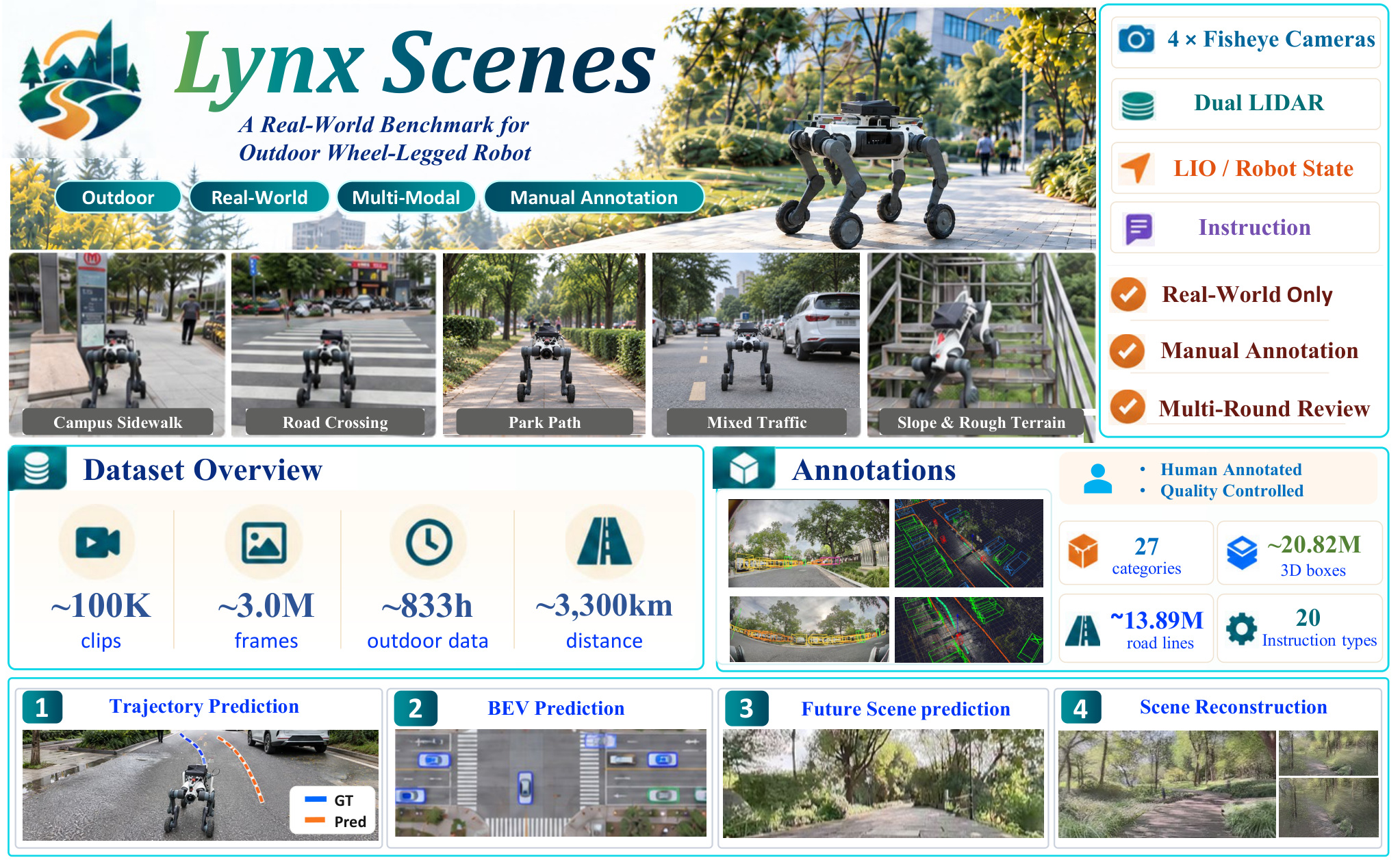
LYNX M20 navigating through a real-world campus environment

Figure 1. LynxScenes unifies real-world multimodal data, dense annotations, and four outdoor robot autonomy tasks.

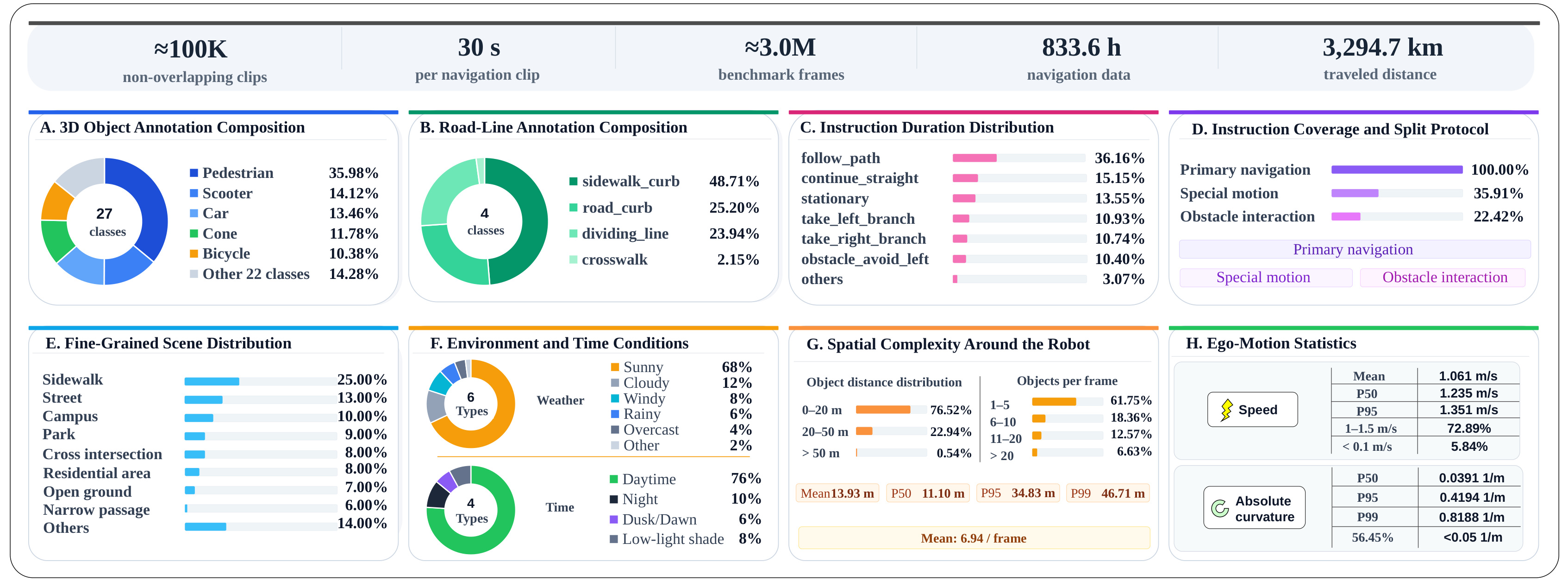
100K30-second clips
3.0Mannotated frames
833.6houtdoor navigation
3,294.7kmtraveled distance

ABSTRACT

A common real-world foundation for outdoor robot autonomy.

Wheel-legged robots operating in outdoor spaces shared with humans require accurate perception, socially compliant navigation, future-scene reasoning, and scene reconstruction. Existing datasets typically support these capabilities in isolation.

LynxScenes brings them together through large-scale synchronized multimodal recordings, dense spatial and behavioral annotations, continuous future trajectories, and a unified evaluation toolkit.

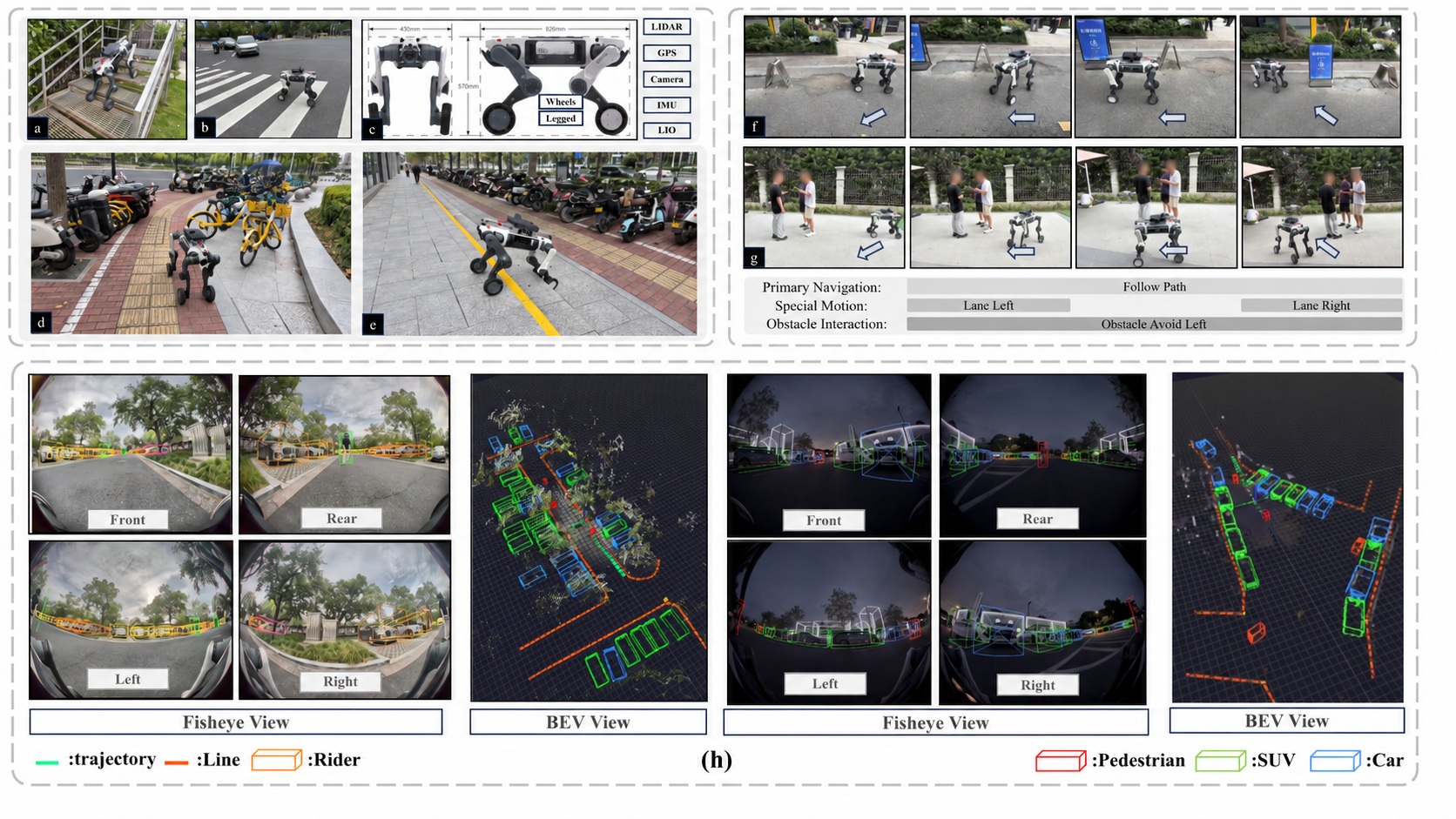
LYNX M20 platform, navigation behaviors, fisheye camera views, LiDAR, and bird's-eye-view annotations with faces blurred

Figure 2. The LYNX M20 platform and multimodal sensing setup, including four fisheye cameras, dual LiDARs, robot motion states, and dense bird's-eye-view annotations for outdoor navigation.

DATASET

Real-world data from a physical LYNX M20.

Every clip synchronizes surround-view vision, geometry, motion, and intent. Trained operators follow a predefined social-compliance protocol, with unsafe or inconsistent demonstrations removed during review.

04
Fisheye cameras
1920 × 1536 · 10 Hz
02
96-channel LiDARs
360° × 90° · 60 m
06
Motion dimensions
IMU + LIO + robot state

ENVIRONMENT COVERAGE

One platform, changing complexity.

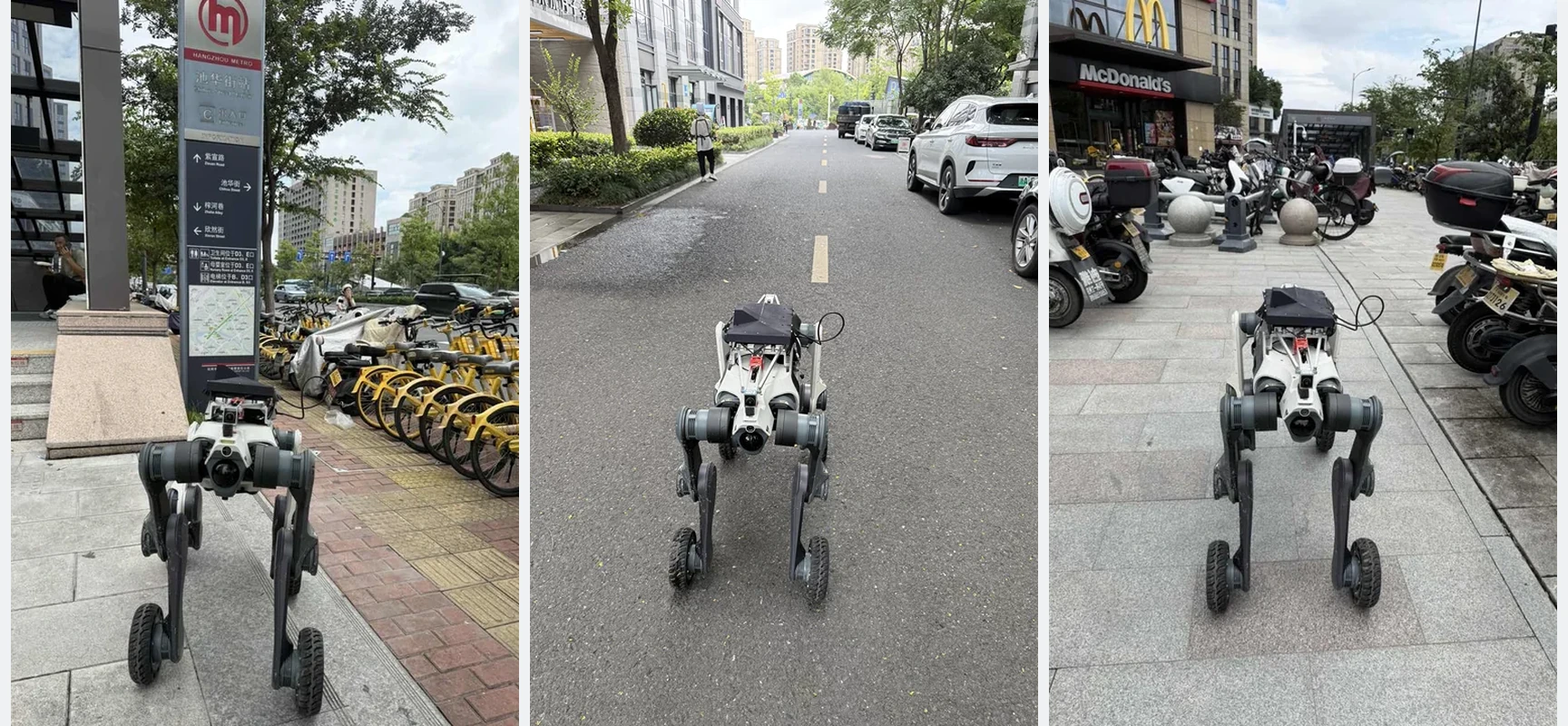
Illustrative views of the close-range, socially shared, and uneven environments targeted by the benchmark.

Three real-world views of the LYNX M20 navigating campus sidewalks and shared paths
Campus flowThree campus-scale navigation views across sidewalks, shared paths, and parked mobility.

BENCHMARK TASKS

Four tasks. One world.

Explore the common evaluation surface spanning action, space, time, and viewpoint.

ACTION / 1 SECOND

Instruction-conditioned trajectory prediction

Predict a complete 10 × 3 future trajectory from sixteen historical images, current robot motion, and a three-layer semantic instruction.

INPUT4 views × 4 timestamps
OUTPUT10 planar poses
LEAD METRICQNS ↑
TOP REPORTED BASELINE 0.843

NaVILA · QNS

The lowest imitation error is not always the safest or most instruction-compliant policy.
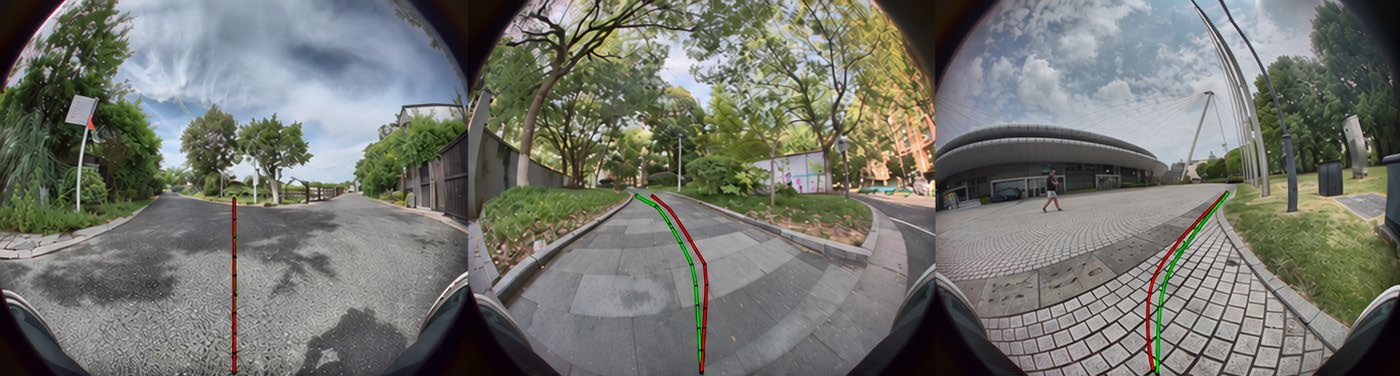
Trajectory prediction. Predicted and ground-truth paths under three navigation instructions.

DATASET STATISTICS

Dense where robot safety lives.

Most annotated objects sit within twenty meters—the range where close interaction matters most.

3D OBJECTS
20.82M

oriented boxes across 27 categories

Pedestrian 35.98% · Scooter 14.12% · Car 13.46% · Other 36.44%
View all 27 object categories
Human · 2

PedestrianPedestrian Accessories

Mobility · 8

BicycleBicycle RiderScooterScooter RiderMotorcycleMotorcycle RiderTricycleTricycle Rider

Vehicle · 5

CarSUVVanTruckBus

Traffic Facility · 5

ConeTraffic BarrierRoad BarrelReflective TriangleFire Hydrant

Other · 7

Robot DogPlatform CartConstruction CartExcavatorForkliftDogCat

SPATIAL COMPLEXITY
0m76.52%20m

Three in four objects are close-range.

Mean object distance: 13.93 m · 6.94 objects per frame

BEHAVIOR INTENT
20

navigation instructions in three independent layers

Primary navigation 6 instructions100%

follow pathcontinue straight at junctiontake left branchtake right branchu turnunknown navigation

Special motion 9 instructions35.91%

stationaryreversingrotate in place leftrotate in place rightlane leftlane rightlateral leftlateral rightmixed motion

Obstacle interaction 5 instructions22.42%

obstacle waitobstacle avoid leftobstacle avoid rightobstacle rerouteunknown obstacle interaction

ROAD STRUCTURE
13.89M

curbs, dividing lines, and crosswalk annotations

4.63 annotations per frame on average
View the full dataset statistics figure Full LynxScenes dataset statistics covering annotations, instructions, scenes, conditions, spatial complexity, and ego motion

EVALUATION

Similarity is not enough.

QNS adds a log-replay-based pseudo-closed-loop view of navigation. A stationary robot may avoid collisions, but it still fails to make progress or follow instructions.

QUADRUPED NAVIGATION SCOREQNS
NCNo collision
×
WACWalkable area
×
EPTTCCLIC weighted navigation quality
SAFETY GATESPROGRESS + MARGIN + INTENT

BASELINE RESULTS

No single model owns the field.

Results reveal different leaders for navigation quality, perception, visual generation, and reconstruction.

TRAJECTORY · QNS ↑

NaVILA

0.843

Best pseudo-closed-loop score among learned policies.

BEV · HDS ↑

BEVFusion

64.48

Highest object detection score with camera + LiDAR input.

FUTURE SCENE · FVD ↓

WorldStereo

386.2

Best distributional realism; other models lead visual quality metrics.

RECONSTRUCTION · PSNR ↑

ReCoSplat

15.94

Best PSNR, LPIPS, and multi-scale structural similarity.

CITATION

Build on the benchmark.

The dataset and evaluation toolkit are planned for public release upon acceptance.

@inproceedings{lynxscenes2027,
  title={LynxScenes: A Large-Scale Real-World Benchmark for
    Outdoor Wheel-Legged Robot Perception, Navigation,
    Imagination and Reconstruction},
  author={Tian, Jun and Wu, Hao and Chen, Ruo and Liao, Yiyi and
    Lin, Hongyi and Yu, Jincheng and Li, Chao and Niu, Yingjie},
  booktitle={International Conference on Learning Representations},
  year={2027}
}